.png)
Case Studies
Air Tightness Test
Scothern Lane, Sudbrooke
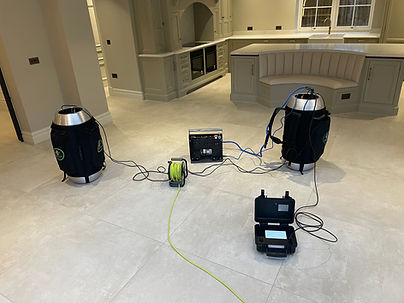

We carried out a pre-completion airtightness inspection on a large 500 m² bespoke dwelling ahead of the final air tightness test.
The property included several challenging junctions and interfaces, such as structural steel elements, complex roof-to-wall junctions, large glazing installations and multiple service penetrations — all areas that can increase the risk of air leakage.
During the visit, we inspected the building envelope and identified potential leakage points around windows, service penetrations and key construction junctions. We provided practical advice to the site team to improve sealing and ensure continuity of the air barrier before the final test.
Following these improvements, the property achieved a good level of airtightness at final testing, particularly impressive considering the size of the dwelling and the complexity of several details.
This project highlights the value of pre-completion airtightness advice, allowing potential issues to be identified early and helping ensure a successful test outcome.
Commercial Premises Converted into an HMO and 2 Self-contained Flats
Grantham


At AirMetric, we were pleased to support the conversion of an existing commercial premises into a new HMO and two self-contained residential flats, providing energy compliance services from the initial design stage through to project completion.
Our involvement began with the preparation of design stage SAP calculations, helping the project team establish the required energy performance specification before works progressed. We then continued to provide energy compliance support throughout the build, helping to address any changes and ensure the development remained on track to meet Building Regulations requirements.
As the project reached completion, we carried out the required air tightness testing and produced the final Energy Performance Certificates for the completed properties. By being involved throughout the process, we were able to provide the client with a consistent point of contact and a straightforward route from initial assessment through to final certification.
This project demonstrates the benefits of using a single energy consultant throughout a development. Whether working on a new build, commercial conversion, HMO or multi-unit residential scheme, AirMetric can provide design stage calculations, ongoing compliance advice, air tightness testing and final EPCs as part of a complete end-to-end service.
Part F Ventilation Testing
Glentham


At AirMetric, we were pleased to support the completion of four new residential properties, providing Part F ventilation testing to ensure the installed mechanical extract systems were operating correctly and meeting Building Regulations requirements.
We carried out testing and commissioning of the bathroom, WC and kitchen extract fans, together with airflow testing to the installed cooker hoods. Using calibrated equipment, we measured the airflow rates from each system to confirm that the required levels of ventilation were being achieved.
Our testing confirmed the ventilation systems were performing as required, with the relevant test results and certification provided for submission to Building Control. This helped the project team demonstrate compliance with Approved Document Part F and progress the properties towards final completion.
This project highlights the importance of correctly testing and commissioning ventilation systems in new homes. By ensuring extract systems are performing as designed, developers can help maintain good indoor air quality, reduce the risk of condensation and mould, and demonstrate compliance with Building Regulations.
Air Tightness Test
Glentham


At AirMetric, We were pleased to support the redevelopment of the former Willows Garden Centre in Glentham, where the site was successfully converted into seven high-quality residential bungalows.
Although air tightness testing was not a specific requirement for the project, the client wanted to ensure the properties achieved a high level of energy efficiency. We worked closely with the developer throughout the process, providing air tightness testing and guidance to help minimise air leakage and improve overall building performance.
Our testing confirmed excellent air tightness results across the development, helping the project team achieve outstanding energy efficiency standards. As a result, all seven bungalows achieved an EPC rating of A, demonstrating the effectiveness of careful construction and attention to airtightness.
This project highlights how air tightness testing can play a key role in improving energy performance, even when not required for Building Regulations. By identifying potential air leakage and ensuring a well-sealed building envelope, developers can significantly enhance comfort, reduce energy use, and improve EPC ratings.
Air Tightness Test
Garden Cottage, Lea


We have recently completed an air tightness test for a new build garden cottage in Lea, helping the project meet the requirements of Part L of the UK Building Regulations.
Using our professional pulse air tightness testing equipment, we measured the air leakage rate of the property to ensure the building envelope was properly sealed and performing efficiently. Air tightness testing is an essential step for new builds, helping to confirm that heat loss is minimised and the property meets modern energy efficiency standards.
The garden cottage successfully passed the air tightness test, demonstrating good construction quality and compliance with current regulations. Following the test, we provided the required certification for submission to Building Control.
At AirMetric, we provide air tightness testing for new builds, extensions and developments across Lincolnshire and surrounding areas, helping builders and developers achieve compliance quickly and efficiently.
Air Tightness Test
Trent View, Marton


At AirMetric, we recently carried out an air tightness test at a new build property in Trent View, Marton, helping the project team meet the requirements of Part L of the Building Regulations.
Using our pulse air tightness testing method, we quickly measured the air leakage rate of the property to ensure the building envelope was properly sealed and performing efficiently.
The property successfully passed the air tightness test, confirming compliance with current energy efficiency standards and allowing the project to proceed to completion.
Following the test, certification was issued for submission to Building Control.
If you require an air tightness test for a new build or development, contact AirMetric to arrange testing.